Starting a commercial flour mill business with a high-efficiency flour mill machine is one of the most stable, high profitable, and unaffected by economic downturns manufacturing opportunities you can launch in 2026. The commercial food processing sector is experiencing a massive, structural shift. Today, a health-conscious India is demanding absolute purity, freshness, and high nutritional value from their daily grains. So, people are shifting back to their roots. They are actively choosing customized milling, organic grains, and premium variations like multigrain flour processed through an advanced, automatic atta chakki machine setup.
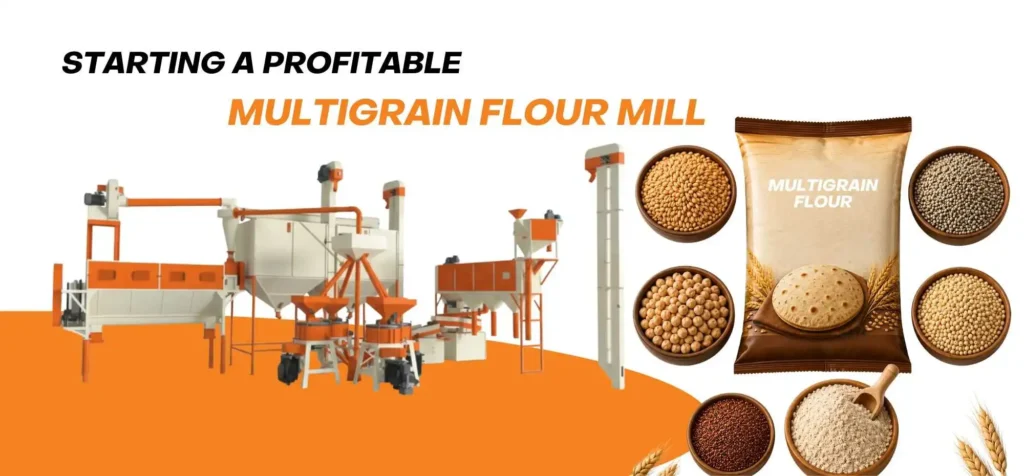
For a forward-thinking entrepreneur or an established trader, this shift presents a goldmine of a business opportunity. So, setting up an industrial-grade production line is a highly profitable decision. Other than this business model remains completely bulletproof against broader market inflations.
When analyzing any food manufacturing business, a digital marketer looks at the baseline consumption metrics. Flour—specifically wheat flour or atta—is not a luxury item. Instead, it is a fundamental daily dietary necessity across millions of households.
As a result, the market demand remains completely unaffected by economic downturns, market inflation, or global supply chain disruptions. In addition, the modern consumer is willing to pay a premium price for health benefits. By shifting from standard old-school milling to a clean, technologically advanced layout, you can easily capture both the high-volume wholesale commercial market and the high-margin premium retail health sector.
To build a highly structured understanding of this business, we will explore the lifecycle of a modern flour mill plant across four critical areas:
Understanding the Machinery Framework (Standard vs. Premium Air-Cooled)
Technical Infrastructure, Space Layout, and Power Infrastructure
Step-by-Step Commercial Processing Workflow
Financial Architecture: Real Cost Breakdown, Profit Margins, and ROI Matrix
The heart and soul of your production facility is your industrial grinding setup. Selecting the right type of commercial atta chakki machine determines your product quality, production capacity, operational costs, and ultimately, your brand’s market reputation.
Traditional stone mills generate immense friction during continuous high-volume operations. This friction spikes the internal temperature of the mill beyond 60 degree cencius to 70 degree calcius Unfortunately, this intense heat burns the delicate gluten content. It also destroys natural vitamins and alters the authentic taste of the flour.
On the other hand, modern commercial flour mill engineering solves this barrier through high-efficiency, balanced systems combined with pneumatic air-cooling technology. By utilizing air-cooled systems, the processing chamber temperature remains low. So, the flour emerges cool. This ensures that the flour preserves its complete nutritional integrity, moisture content, and natural aroma—the exact qualities that modern organic food consumers look for.
When selecting your primary grinder, check out our heavy-duty Samtek Automatic 24-Inch Atta Chakki Machine engineered for high industrial output. If you plan to diversify your factory infrastructure later, read our guide on setting up a companion Stainless Steel Masala Plant for dual revenue.
A fully operational commercial milling plant is not just a standalone grinding machine. Instead, it is a tuning in sequence of industrial equipment designed to deliver maximum output quality:
[Raw Grain Intake]
│
▼
[3 in 1 Cleaning Machine / Cleaning] ──────> Removes Stones, Dust & Chaff
│
▼
[Heavy Atta Chakki Machine] ──> High-Precision Cold Grinding
│
▼
[Centrifugal Separator] ───> Grades Fine Atta vs. Uniform Daliya
│
▼
[Packaging System] ────────> High-Speed Semi-Automatic Sealing
Grain Winnower and Cleaner (Sifter): Before any grain enters the milling chamber, it must be thoroughly cleaned. This machine uses multi-layered vibration screens and air-blowers to isolate stones, mud particles, chaff, and external debris from the raw wheat.
Atta Chakki Machine: This is the heavy-duty commercial unit where the actual grinding happens. For this reason, a 24-inch or larger balanced grinding system is highly recommended to manage continuous production stresses.
Centrifugal Separator / Sifter: Once the wheat is ground, the flour passes through a high-speed centrifugal separator. This component filters and separates uniformly ground fine atta from coarser textures like high-protein daliya or bran. Thus, it ensures absolute consistency in your final packaged product.
Pneumatic Cyclone and Air-Lock System: This mechanism pulls the ground flour from the grinding chamber using airflow. Together, it cools the product rapidly during transit and drops it smoothly into the collection bins without generating loose industrial dust on the factory floor.
Operating an industrial-scale manufacturing plant requires proper commercial planning. You cannot treat an industrial milling unit like a small domestic appliance; rather, it demands a solid infrastructure layout.
To install a professional flour mill plant, such as a high-capacity 250 Kg/HR to 500 Kg/HR commercial setup, you require a dedicated, structurally sound space. Specifically, a small retail shop or a mini-warehouse of 300 to 500 square feet is highly ideal.
The space must feature clean concrete flooring to easily support heavy-duty machinery vibration. Additionally, it requires proper ventilation to handle throws out the heat, and a dry, moisture-free storage zone to protect both raw grains and final packed bags from to deteriorate.
One of the most critical elements where new entrepreneurs make errors is planning their electrical infrastructure.
A commercial flour mill machine designed for continuous heavy-duty processing cannot operate on a domestic single-phase power line. Attempting to run industrial motors (15 HP to 40 HP or higher) on a home line will cause immediate voltage drops. Moreover, it will trigger circuit breaker failures and risk burning the expensive copper windings of your motor.
Therefore, securing a Commercial 3-Phase Power Connection from your local electricity board is absolutely non-negotiable. Before applying for your 3-phase connection, check the industrial power load guidelines on the official Paschimanchal Vidyut Vitran Nigam Ltd (PVVNL) portal.
In short, a 3-phase system ensures a balanced electrical load across all conductors. It maintains steady voltage levels under heavy load spikes. As a result, it optimizes your power consumption efficiency, saving you thousands of rupees in monthly operational costs.
To maintain clean food safety standards and maximum operational efficiency, your facility must follow a smooth, linear assembly line process. Undoubtedly, this layout minimizes labor requirements and cuts down material handling time.
Stage |
Process Name |
Machinery Used |
Quality Check |
|---|---|---|---|
Stage 1
|
Raw Material Intake & Cleaning
|
Industrial Reel Sifter / Winnower
|
Ensure 100% extraction of stones and dust to protect the main grinding plates from damage.
|
Stage 2
|
Controlled Proportional Blending
|
Manual or Automated Hopper Mixing
|
Maintain strict weight ratios of wheat, chana, or bajra to ensure consistent taste for multigrain lines.
|
Stage 3
|
High-Precision Grinding
|
Heavy-Duty Air-Cooled Flour Mill Machine
|
Monitor air-cool discharge to verify the flour remains at room temperature during output.
|
Stage 4
|
Industrial Sifting & Sizing
|
Centrifugal Separator
|
Isolate uniform grade superfine atta from commercial daliya to ensure smooth baking quality.
|
Stage 5
|
Bulk Packaging & Sealing
|
Semi-Automatic Pouch Sealer / Bagger
|
Verify airtight heat-sealing to prevent moisture ingress and extend product shelf-life.
|
Let us dive deep into the numbers. To run a successful commercial flour mill project, you must clear out all vague assumptions. Instead, let us look at the exact financial processing math.
The following calculations represent a highly realistic commercial blueprint based on a medium-scale 500 Kg/HR Atta Chakki Plant operating for a standard 8-hour daily shift. For structural business funding, you can evaluate financial credit subsidies under the government’s Pradhan Mantri Mudra Yojana (PMMY) portal.
Raw Material Procurement (Premium Wheat Mix): ₹ 25.00\per Kg
Industrial Electricity Consumption (3-Phase Grid Cost): ₹ 1.50\per Kg
Labor, Logistics, and Packaging Pouch Expenses: ₹ 1.50\per Kg
Total Cost of Production (Finished Product Ready for Dispatch):
In the modern market, pure, unadulterated premium quality flour commands excellent wholesale and retail pricing.
Average Wholesale Selling Price (To Local Kirana Stores & Supermarkets): ₹36.00\per Kg
Net Profit Margin per Kilo:
Hence, even if you factor in conservative market fluctuations, introductory dealer discounts, and variable monthly asset maintenance overheads, a well-managed commercial flour mill unit easily yields a stable, liquid net cash flow of ₹5 Lakhs to ₹6 Lakhs per month. undoubtedly, this high profitability ensures that the initial capital expenditure on your heavy-duty machinery can be fully recovered within the first 6 to 8 months of launch, representing an incredible Return on Investment (ROI) benchmark.
If you want to beat the local market competition and establish a highly dominant commercial brand name, you should expand into the premium Multigrain Atta Business.
[Standard Wheat Flour] ───────────────> Thin Margins, High Local Price Competition
[Premium Multigrain / Organic Flour] ──> 40%+ Gross Margins, Strong Brand Loyalty
Modern health trends indicate that consumers are actively searching for high-protein, low-carbohydrate options containing essential dietary fibers. Therefore, instead of milling plain wheat, you can blend premium grains using a precise formulation:
Because multigrain combinations are perceived as premium wellness and diet products, their retail packaging market price easily jumps to ₹50.00 to ₹65.00 per Kg. However, your raw ingredient mixing cost increases by only a few rupees. So, this instantly broadens your net profit margin by an additional 30% to 40%, helping you capture high-income urban residential zones and specialized modern retail stores.
To keep your factory floor running smoothly without facing sudden production drops or expensive machinery breakdown costs, your team must adhere to strict maintenance checks:
Grinding Plate Inspections: Check the alignment and wear pattern of your processing plates or stones every 100 hours of continuous grinding to maintain a uniform fine flour mesh size.
3-Phase Power Audits: Install a dedicated heavy-duty stabilizer and VFD (Variable Frequency Drive) panel. Other than this, regularly check that all 3 phases are delivering stable, uniform voltage without any phase-lag to protect your main motor from burning out.
Bearing Lubrication: High-speed processing shafts endure massive mechanical load forces. So, lubricate all internal rotary bearings with food-grade industrial grease weekly to prevent friction damage.
Pneumatic Dust Cleansing: Clean the air-lock mechanisms and cyclonic filtration screens daily. By doing this, you prevent fine flour accumulation, ensuring 100% air-cooled cooling performance.
In conclusion, launching a commercial flour mill business is one of the most stable, profitable, and scalable production decisions you can make in 2026. By moving away from old grinding setups and adopting a high-precision, air-cooled atta chakki machine driven by a durable commercial 3-phase power line, you can easily bridge the massive market gap between local grain supply and premium healthy demands.
So, do not stay limited to thinking about local jobs or small trading models. Take charge of your manufacturing journey, structure your financial investment blueprint wisely, build a clean high-tech facility, and set up your own highly profitable food processing brand today!
© 2023 Samtak Engineeing And GIS Solutions Private Limited